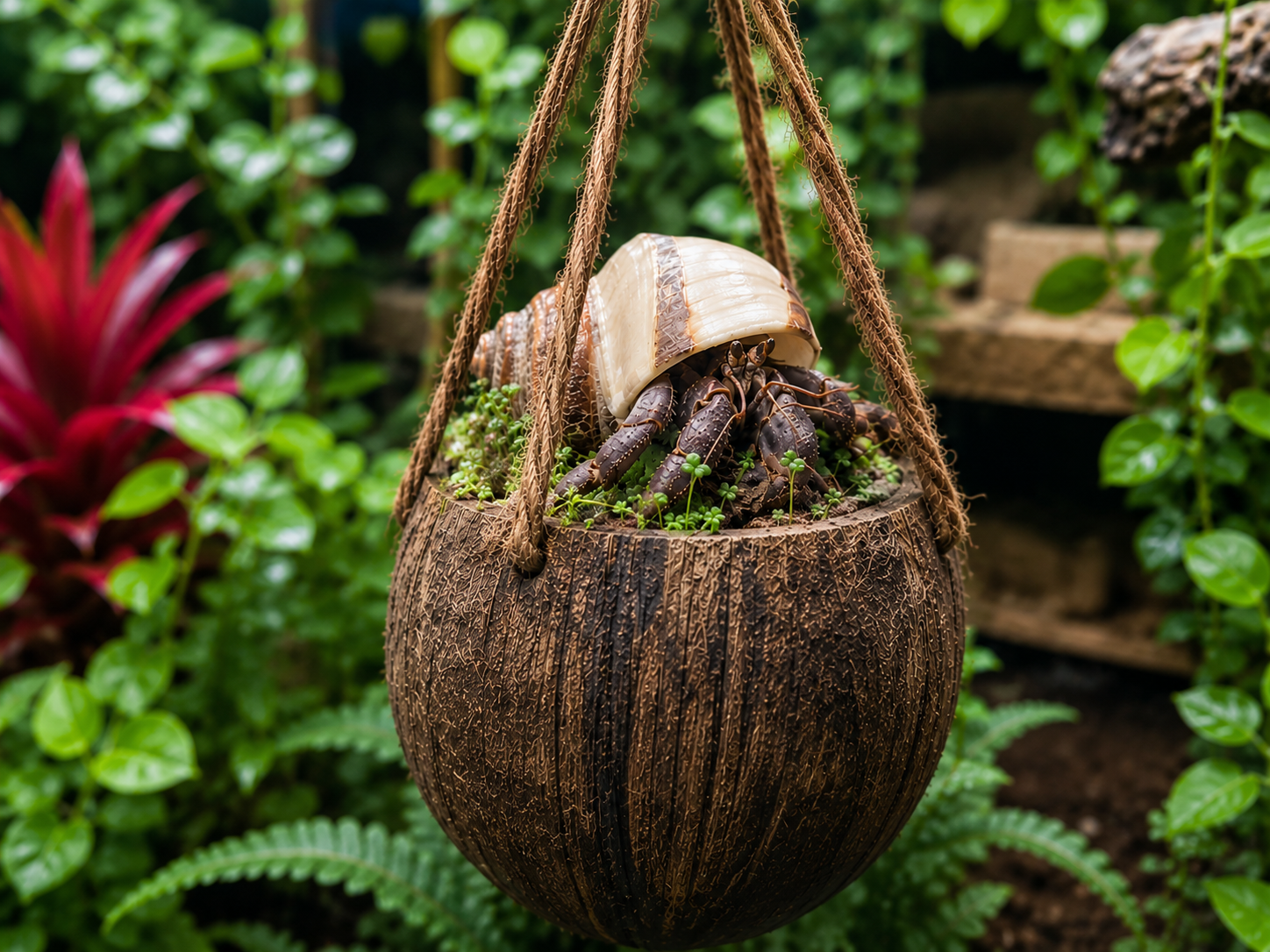
Dupond and Dupont came to me as rehomes from a family whose kid had moved on to other things, and many years later they’re still teaching me something new every season. They’re named after the Tintin detectives because they kept swapping shells, making it impossible to tell who was who. One has since outgrown the other, which finally blew their cover.
Their home is two 30 gallon aquariums stacked into a climbing tower, because hermit crabs are surprisingly athletic explorers, with 8 inches of sand for digging, both saltwater and freshwater pools, and humidity kept above 80%. That last part isn’t optional: hermit crabs breathe through modified gills and would slowly suffocate in dry air. They’re observe-only pets, though after all these years they no longer hide when I approach. Favorite treats include worm castings and the fresh clover sprouts I plant right in their enclosure.
Land hermit crabs (genus Coenobita) are not true crabs and are not actually hermits. In the wild, they live in large social colonies along tropical shorelines, and they can live several decades with good care, often outliving the family dog. Because their soft abdomen has no shell of its own, they borrow discarded sea snail shells and trade up as they grow. Dupond and Dupont are partial to turbo shells, which get genuinely hard to find in their size now that they’ve grown so much.
Fun fact: when a good empty shell washes ashore, hermit crabs will line up beside it from biggest to smallest and wait. When the biggest crab moves into the new shell, the next one takes its old home, and so on down the line, so one lucky find can rehouse the whole queue. It’s called a vacancy chain, and it’s one of the animal kingdom’s best examples of an orderly housing market.
Animal Profile
| Species Group |
Invertebrate |
| Scientific Name |
Coenobita Clypeatus |
| Common Name |
Purple Pincher |
| Sex |
Unknown |
| Source |
Rescue |
| Acquisition Date |
July 1, 2021 |
| Time in Collection |
5 years |
| Native Region |
Caribbean Shoreline, Puerto Rico |
Native Region
Every animal in the collection is native to a specific region, which is marked on the map below.
Caribbean Shoreline, Puerto Rico
Home vs. Native Weather
Every enclosure here recreates a slice of a real place. This is the weather at home in Montréal right now, side by side with the weather in this animal’s native range on the other side of the world.
|
Montréal |
Caribbean Shoreline, Puerto Rico |
| Local Time |
6:45 PM |
6:45 PM |
| Season |
Summer |
Summer |
| Conditions |
Overcast |
Partly cloudy |
| Today High / Low |
30.2 °C / 20.6 °C |
34.2 °C / 25.4 °C |
| Air Humidity |
49 % |
67 % |
| Precipitation Today |
0.6 mm |
0 mm |
☁️
26 °C
Overcast · Montréal
⛅
28.8 °C
Partly cloudy · Caribbean Shoreline, Puerto Rico
MontréalCaribbean Shoreline, Puerto Rico
Enclosure Setup
Reptiles and amphibians depend on their enclosure to provide the right space, heat, and light that their bodies can’t generate themselves. This table includes information about this enclosure’s dimensions, type, and heating and lighting equipment.
| Enclosure ID |
C |
| Enclosure Type |
Glass Terrarium |
| Length |
30 inches |
| Width |
12 inches |
| Height |
36 inches |
| Floor Space |
2.5 square feet |
| Volume |
56.1 gallons |
| Heat Lamp |
No |
| UVB Lamp |
No |
Enclosure Climate
Reptiles and amphibians require specific environmental parameters to regulate their temperature, digest, and stay healthy. The charts below show the live soil moisture, air humidity, and temperature inside the enclosure.
Bioactive Setup
A bioactive enclosure is a self-sustaining ecosystem where live plants, natural substrate, and invertebrate cleanup crews break down waste the way a forest floor does. This table includes information about how this enclosure’s system is set up.
| Drainage Layer |
1 inch |
| Substrate |
Coco Coir, Sand |
| Substrate Depth |
9 inches |
| Leaf Litter |
Forest Floor |
| Live Plants |
Yes |
| Cleanup Crew |
Isopods, Springtails |
| Mistings Per Day |
3 |
| Misting Duration |
30 seconds |
Staple Foods
Staple foods provide the macro and micronutrients an animal needs to stay healthy, from protein and fat to calcium and vitamins. Below are the food sources that make up most of this animal’s diet.
Occasional Treats
Treats add variety and enrichment, engaging an animal’s sense of taste and its instinct to hunt. Below are the foods this animal enjoys from time to time.
Enclosure Timelapse: Past Hour
Snapshots of the enclosure from the last hour, taken five minutes apart and replayed as a timelapse.
Enclosure Timelapse: Past Day
One snapshot of the enclosure from each of the last 24 hours, replayed as a timelapse.
Enclosure Heatmap: Past Week
Movement detected between camera snapshots, overlaid on the enclosure between 9 AM and 9 PM. The deeper the red, the more this animal has been active in that spot.
12,126 motion events recorded