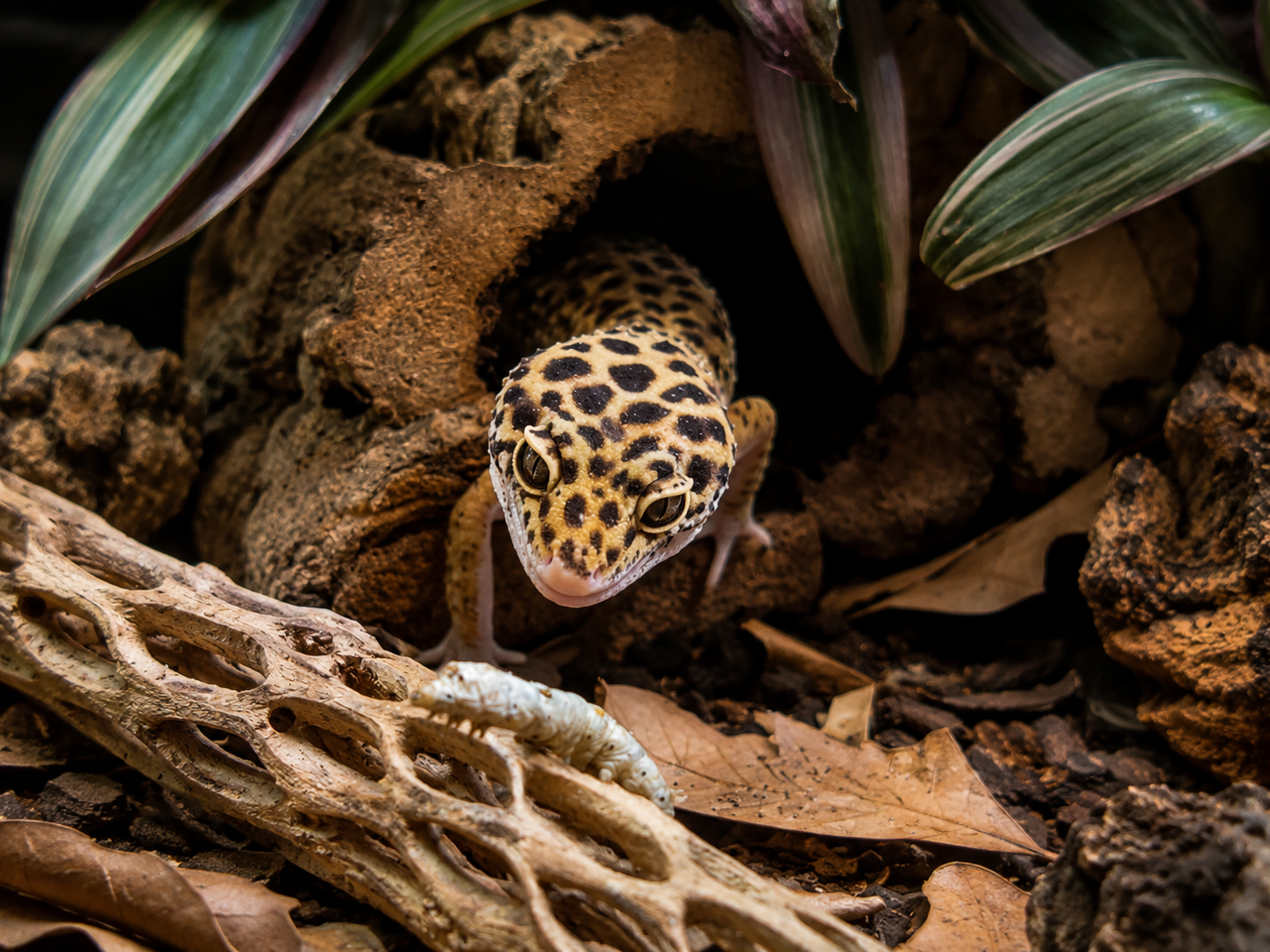
Cleo came to me as a surrender, severely underweight. Rebuilding her health was a labor of love, one insect at a time. You can actually read a leopard gecko’s health right off her tail, which is where they store fat like a camel’s hump.
Cleo’s name comes from her stunning eyes, outlined in black like Elizabeth Taylor playing Cleopatra. These days she lives in a fully bioactive enclosure planted with succulents and other semi-arid plants, and her favorite spot in is soaking up warmth in her rock hide.
Leopard geckos (Eublepharis macularius) come from the rocky, dry grasslands of Afghanistan, Pakistan, and northwestern India. They’re crepuscular, meaning most active at dawn and dusk, which is why the best Cleo viewing hours are early and late. Unlike most geckos, they have eyelids, which means Cleo can blink. With good care, they can live 20 years or more.
Fun fact: a leopard gecko can drop its tail to escape a predator, leaving it wriggling behind as a decoy, and then grow a new one. And despite the fierce name, their “leopard” spots don’t appear until adulthood: babies are striped, not spotted.
Animal Profile
| Species Group |
Reptile |
| Scientific Name |
Eublepharis Macularius |
| Common Name |
Leopard Gecko |
| Sex |
Female |
| Source |
Rescue |
| Acquisition Date |
April 13, 2022 |
| Time in Collection |
4.3 years |
| Native Region |
Balochistan Drylands, Pakistan |
Native Region
Every animal in the collection is native to a specific region, which is marked on the map below.
Balochistan Drylands, Pakistan
Home vs. Native Weather
Every enclosure here recreates a slice of a real place. This is the weather at home in Montréal right now, side by side with the weather in this animal’s native range on the other side of the world.
|
Montréal |
Balochistan Drylands, Pakistan |
| Local Time |
7:45 PM |
4:45 AM |
| Season |
Summer |
Summer |
| Conditions |
Partly cloudy |
Partly cloudy |
| Today High / Low |
30.2 °C / 20.6 °C |
36.3 °C / 20.7 °C |
| Air Humidity |
55 % |
80 % |
| Precipitation Today |
0.6 mm |
0 mm |
⛅
22.4 °C
Partly cloudy · Montréal
🌙
21.3 °C
Partly cloudy · Balochistan Drylands, Pakistan
MontréalBalochistan Drylands, Pakistan
Enclosure Setup
Reptiles and amphibians depend on their enclosure to provide the right space, heat, and light that their bodies can’t generate themselves. This table includes information about this enclosure’s dimensions, type, and heating and lighting equipment.
| Enclosure ID |
F |
| Enclosure Type |
Glass Terrarium |
| Length |
24 inches |
| Width |
18 inches |
| Height |
18 inches |
| Floor Space |
3 square feet |
| Volume |
33.7 gallons |
| Heat Lamp |
50 watts |
| UVB Lamp |
No |
Enclosure Climate
Reptiles and amphibians require specific environmental parameters to regulate their temperature, digest, and stay healthy. The charts below show the live soil moisture, air humidity, and temperature inside the enclosure.
Bioactive Setup
A bioactive enclosure is a self-sustaining ecosystem where live plants, natural substrate, and invertebrate cleanup crews break down waste the way a forest floor does. This table includes information about how this enclosure’s system is set up.
| Drainage Layer |
1 inch |
| Substrate |
Organic Soil, Coco Coir |
| Substrate Depth |
7 inches |
| Leaf Litter |
Forest Floor, Sphagnum Moss |
| Live Plants |
Yes |
| Cleanup Crew |
Isopods, Springtails |
| Mistings Per Day |
3 |
| Misting Duration |
29 seconds |
Staple Foods
Staple foods provide the macro and micronutrients an animal needs to stay healthy, from protein and fat to calcium and vitamins. Below are the food sources that make up most of this animal’s diet.
Occasional Treats
Treats add variety and enrichment, engaging an animal’s sense of taste and its instinct to hunt. Below are the foods this animal enjoys from time to time.
Enclosure Timelapse: Past Hour
Snapshots of the enclosure from the last hour, taken five minutes apart and replayed as a timelapse.
Enclosure Timelapse: Past Day
One snapshot of the enclosure from each of the last 24 hours, replayed as a timelapse.
Enclosure Heatmap: Past Week
Movement detected between camera snapshots, overlaid on the enclosure between 9 AM and 9 PM. The deeper the red, the more this animal has been active in that spot.
3,670 motion events recorded